Dev Blog #8 Town Market. The Heart of the Town
The Supply Heart of the City
Hello everyone!
Today we want to talk about one of the most important buildings in Age After Age is the Town Market.
If production is the body of the city, then the Town Market is its circulatory system.
It is the place where goods finally become something meaningful for society:
- daily life support
- approval
- tax-related value
- and, of course, money
The Town Market is the last major step in the chain from investment → raw resources → materials → finished goods → money.
What the Town Market Does
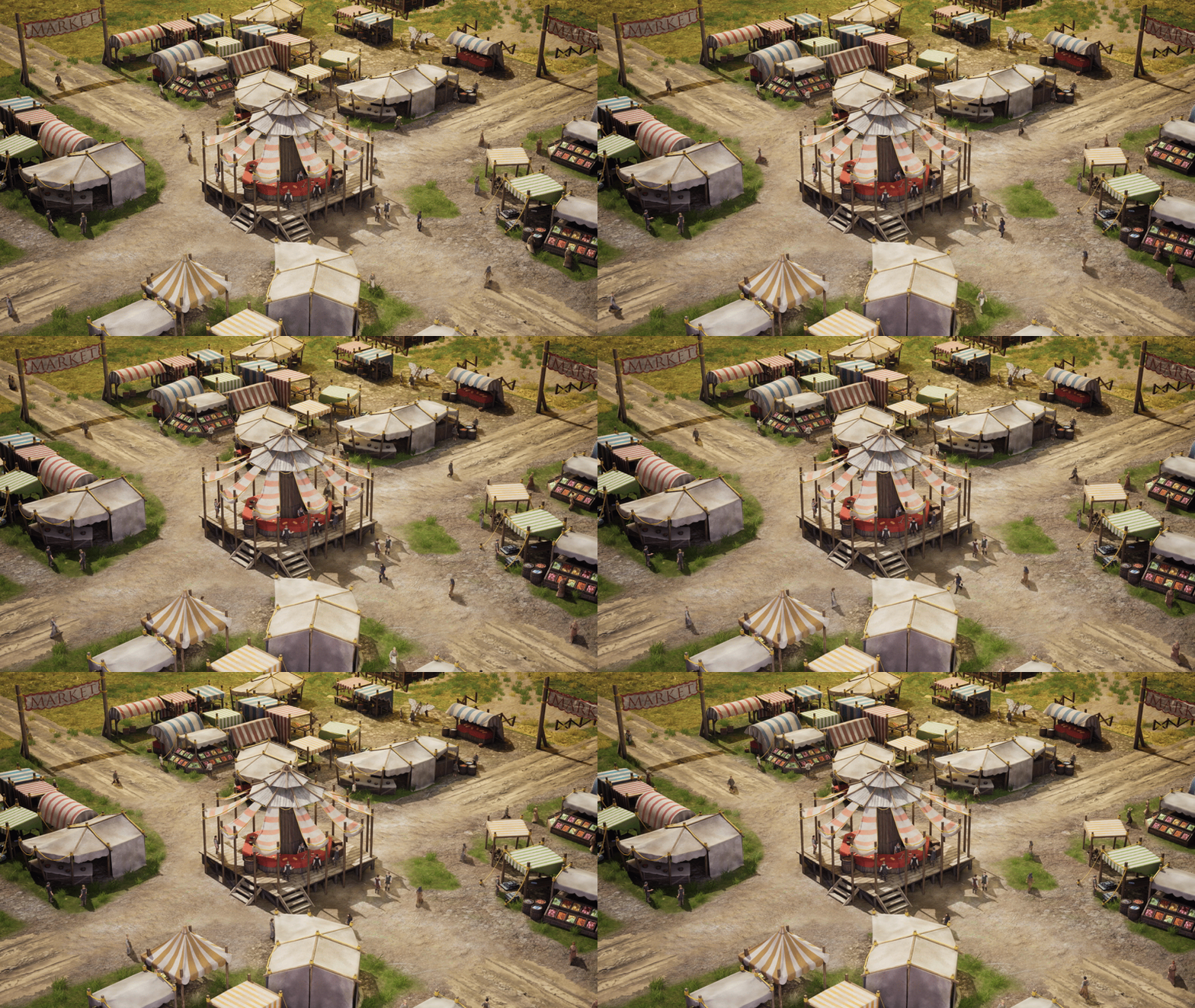
The Town Market is a large and highly important building that allows nearby citizens to purchase the goods they need for:
- survival - food and fuel for heating
- comfort - clothes, furniture
- Riches - if people are rich they are able to buy jewelry, weapon and other expensive stuff
This is where your city’s production chain meets citizen demand.
It transforms logistics and industry into:
- affordability - depending on supply/demand ration
- approval - people do like being able to buy stuff
- internal economic activity - allows to transform goods into money and money into investment.
The Town Market is not just a store.
It is the main interface between the economy and the population.
Shopping Cycles
In Age After Age, citizens make shopping trips every 6 in-game hours.
We call these intervals cycles.
Every cycle is effectively a live summary of your city management:
- Are your production chains stable?
- Are your logistics routes optimized?
- Are your storages supplying the right goods and has the capacity to support high demand?
- Can people afford what they need?
When a new cycle begins, citizens go to the market and try to buy:
1. the goods they need
2. the goods they want, if they can afford them
This makes each cycle a direct reflection of your planning quality.
If the city is well-managed, the market feels healthy.
If the city is poorly balanced, the market reveals the consequences very quickly.
Work, Affordability, and Subsidies
For citizens to buy goods, they must have money. And in most cases, that means they must have work.
Employment is what allows the market to function as a social stabilizer.
A working population buys goods, supports internal demand, and keeps approval stable.
There are, of course, subsidies that can support the needy.
Subsidies can:
- help citizens afford essential goods
- improve approval
- reduce social pressure in difficult periods
But subsidies are not free. They directly drain the city’s reserves, so while they can stabilize a crisis, overusing them may weaken your long-term economy.
They are a support tool not a replacement for a functioning city.
Supply, Demand, and Price Manipulation
The Town Market is also where the city’s internal supply and demand system becomes visible.
Every cycle updates the relationship between:
- available goods
- citizen demand
- affordability
- internal prices
This means the player can actively influence the internal market.
Artificial Shortage
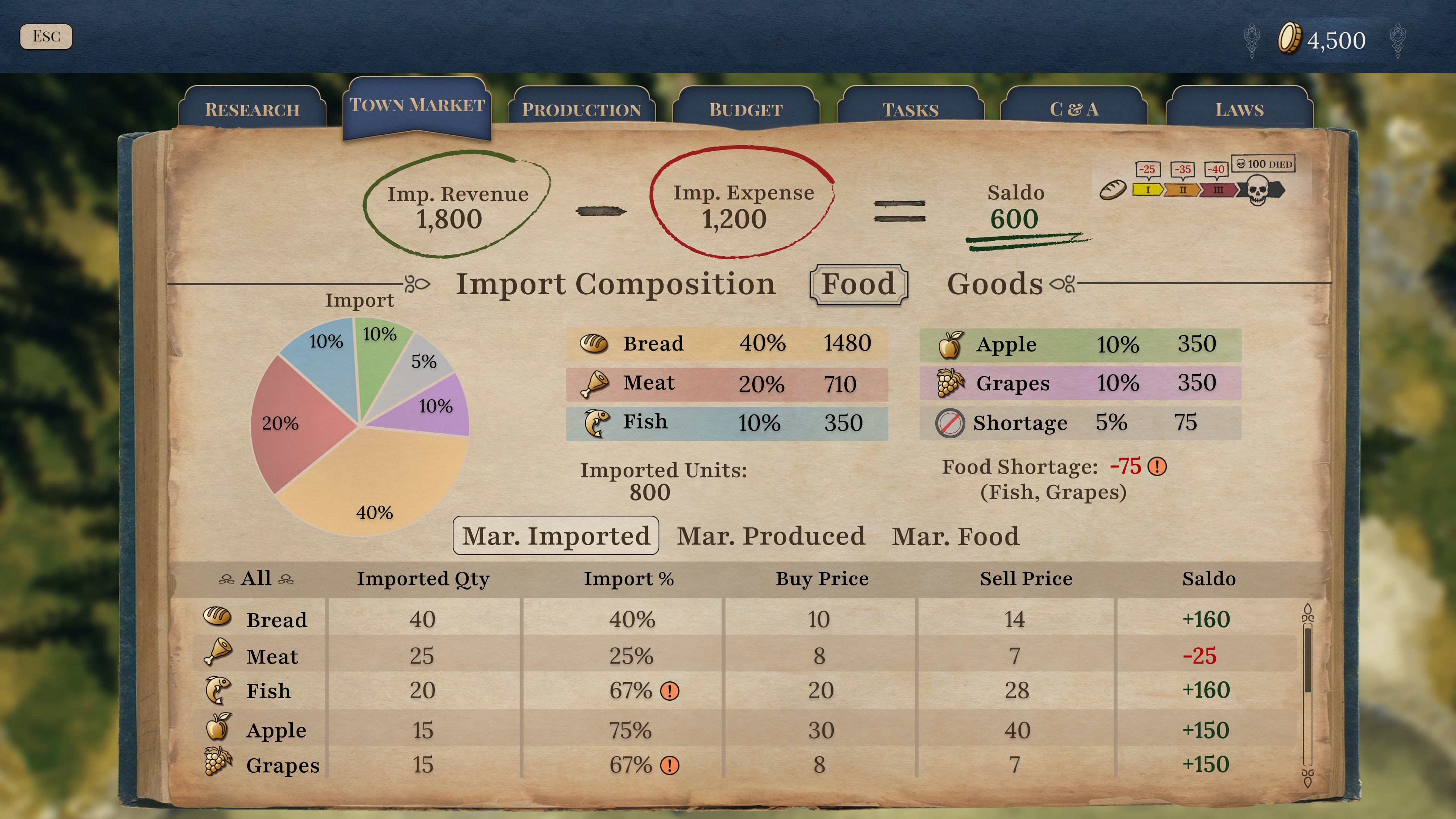
If you limit the amount of goods delivered to the market, you can create an artificial shortage.
This leads to higher prices in future cycles.
Done carefully, this can allow the player to earn additional money and create reserves for future investments.
But the tradeoff is obvious:
- fewer people can afford goods
- approval may fall
- shortages may create instability
The market can be manipulated but it always pushes back.
Oversupply
If you flood the market with goods, prices will fall during future cycles. At first glance, this may look bad from a profit perspective.
But it also increases affordability.
More citizens are able to buy what they need and want, which means:
- higher satisfaction
- more approval generation
- better support for future laws and reforms
So the Town Market is not only a source of income.
It is a political and social balancing tool.
Approval, Money, and Control
The Town Market allows the player to control several critical systems at once:
- internal market prices
- citizen affordability
- approval generation
- income from goods circulation
- priority of specific goods
Because of this, the market becomes one of the central control points of the city.
It allows players to decide:
- when to prioritize profit
- when to prioritize stability
- when to support reform
- when to prepare for crisis
A strong market means a stable society.
A badly managed one can destabilize everything very quickly.
Deficit, Crime, and the Black Market
Shortages do not only hurt approval they also affect crime.
If people have money, but no legal way to buy the goods they need, they will look for alternatives.
That is where the Black Market appears.
The Black Market is not directly controlled by the player.
It acts as a shadow response to city failure:
- it helps people avoid complete collapse
- but it increases crime levels
- and weakens legal market price control
In other words, it prevents immediate death but creates deeper long-term problems. Unemployment also contributes to this problem. If people have no work and no access to goods, both approval and public order begin to deteriorate.
Law Enforcement and Political Cost
The Black Market can be countered by law enforcement.
But that solution has its own consequences.
Cracking down on illegal trade may reduce crime, but if citizens still have no legal alternative to obtain goods, they will die or push against such decisions.
This creates a difficult political dilemma:
- tolerate instability to preserve life and sacrifice the profit
- or enforce order and risk public backlash but keep money coming
Like many systems in Age After Age, the Town Market is not about a single “correct” answer.
It is about managing consequences.
What Happens If the Market Fails?
Because the Town Market sits at the center of city life, disabling it can have massive consequences.
This may happen because of:
- disaster damage
- broken logistics connections
- storage shortages
- broader economic collapse
If the market stops functioning, the city enters a dangerous state very quickly:
- citizens cannot complete shopping cycles properly
- needs remain unsatisfied
- approval falls
- crime begins to grow
- economic pressure rises
This can become a disaster or an opportunity.
A player may try to exploit instability for short-term gain, or step in to support the population and restore order. Both approaches are possible. Both come with consequences.
Town Market will be always in players attention, and will always show the results of short and long term decisions.
Thank you for your time, stay tuned and cya guys next dev blog!
SOCIAL PAGES:
LinkedIn
FaceBook
Instagram
Threads
MEDIA:
Steam
Youtube
ArtStation
More posts
We've been hard at work fixing bugs and enhancing the game. Exciting updates include squad member icons on the map for better coordination and improvements to water physics.
Improved damage resistance for gear, transitioning to UE 5.1 input system, and enhancing visual effects for explosions. Bug fixes in progress.
Bug fixing ongoing. New meshes for car service centers in progress. Preparing update for public tests focusing on NPC and AI. Join us in the test branch for early testing.
This week: Completed new craft method requiring time and attention. Added sound effects for crafting. Introducing a fire watchtower level with strategic positions.